High‑pressure microfluidization technology effectively addresses key bottlenecks in the preparation of coenzyme Q10 formulations while efficiently preserving biological activity. It serves as a preferred manufacturing process for high‑quality CoQ10 products.
1. Core Functions and Application Advantages of Coenzyme Q10
The core strengths of coenzyme Q10 lie in three dimensions: potent anti‑oxidation and anti‑ageing, cellular energy support, and skin‑barrier repair. Featuring high safety and good ingredient compatibility, it is a premium raw material for functional products. Its specific functions are outlined below:
As a powerful natural free‑radical scavenger, coenzyme Q10 outperforms vitamin E in antioxidant capacity. It effectively eliminates cellular reactive oxygen species, blocks oxidative damage, reduces fine lines, dullness and pigmentation, and mitigates skin damage induced by ultraviolet radiation and environmental pollutants, thereby delaying cutaneous and systemic ageing. It is a well‑established anti‑ageing active ingredient.
Coenzyme Q10 participates directly in cellular ATP synthesis to supply energy for physiological activities.
It accelerates skin metabolism, repairs impaired skin barriers, improves skin moisture retention and cutaneous resistance, and relieves dryness, redness and sensitivity.
With mild properties and excellent biocompatibility, coenzyme Q10 can be compounded with peptides, vitamins, plant extracts and numerous other ingredients. It finds extensive applications in anti‑ageing skincare, functional dietary supplements and biomedical preparations, accompanied by continuously growing market demand.
2. Core Pain Points and Industrial Challenges of Coenzyme Q10 Prepared by Conventional Processes
Extremely low water‑solubility of coenzyme Q10 allows only simple mixing in conventional workflows. Insufficient particle size reduction and severe particle agglomeration result in broad particle‑size distribution. Finished products are prone to stratification, precipitation and turbidity, with poor shelf‑life stability and compromised appearance and quality.
Products processed by traditional methods mostly contain micron‑sized particles with heterogeneous particle‑size profiles. For oral products, gastrointestinal absorption rates fall below 30 %, with most active ingredients excreted unutilized. For skincare products, ingredients remain confined to the skin surface and cannot penetrate the stratum corneum, leading to weak deep‑layer anti‑ageing and repair effects and poor product cost‑effectiveness.
Coenzyme Q10 is sensitive to light, oxygen and temperature. Conventional processes suffer from inadequate shearing, excessive processing cycles and poorly‑controlled temperature rise. Oxidation and thermal inactivation readily occur during manufacturing, causing significant loss of core bioactivity and greatly diminished end‑product performance.
In liposome and nanoemulsion production, traditional processes deliver poor encapsulation performance and low encapsulation efficiency. Active ingredients easily leak and degrade. Rapid efficacy decay and large batch‑to‑batch variations fail to meet quality standards for high‑end products.
Conventional equipment offers limited process controllability and heavy human‑factor interference. Noticeable discrepancies exist among lab‑scale, pilot‑scale and full‑scale batches. Poor batch consistency prevents standardized and large‑volume manufacturing and restricts enterprise production capacity and product upgrading.
3. High‑Pressure Microfluidization Technology: An All‑in‑One Solution for Coenzyme Q10 Preparation
The high‑pressure microfluidization homogenizer is purpose‑built for nanopreparation of poorly‑soluble active components. Leveraging high‑pressure microfluidic nano‑homogenization technology and precise physical processing, it comprehensively solves difficulties concerning coenzyme Q10 dispersion, particle‑size control, bioactivity preservation, product stability and scale‑up. It enables manufacture of high‑activity, high‑permeability and highly stable CoQ10 formulations.
High‑pressure force propels material through diamond microchannels. Combined instantaneous intense shearing, cavitation and high‑velocity impaction reduce coenzyme Q10 particles precisely to 50‑150 nm, with PDI as low as 0.1. Particle size is uniform without agglomeration. Compared with ordinary homogenizers, material loss is eliminated and stress distribution is homogeneous. Nano‑scale stable dispersion can be achieved in a single homogenization pass, fundamentally eliminating stratification and precipitation.
For liposome and nanoemulsion systems, the equipment achieves efficient encapsulation of coenzyme Q10, with stable encapsulation efficiency ≥ 90 % and maximum values up to 96 %. Dense, homogeneous nanostructures shield active ingredients from light, oxygen and thermal stress, suppress ingredient degradation, extend shelf‑life and enable sustained‑release delivery of functional components.
Thanks to instantaneous processing together with chilled‑water temperature control, temperature elevation is strictly restricted. Oxidation and thermal inactivation of coenzyme Q10 induced by high temperature or prolonged processing are avoided, native biological activity is largely retained, and core product functions including antioxidation and skin repair are guaranteed.
Nanoscale fine particles exhibit superior penetration. Skincare formulations deliver anti‑ageing and repair effects deep within skin tissue; oral formulations achieve rapid human absorption and greatly improved bioavailability. This resolves the long‑standing shortcoming of conventional CoQ10 products: high nominal content paired with poor absorption and weak practical efficacy, and brings functional benefits into full play.
Fixed‑geometry micro‑channel design ensures precise process‑parameter control and high batch‑to‑batch consistency. Seamless linear scale‑up from laboratory‑scale to pilot‑scale and commercial‑scale production is realized without process deviation. It satisfies stringent manufacturing requirements for cosmetics and biomedicine and supports standardized, large‑scale manufacture of premium‑grade coenzyme Q10 products.
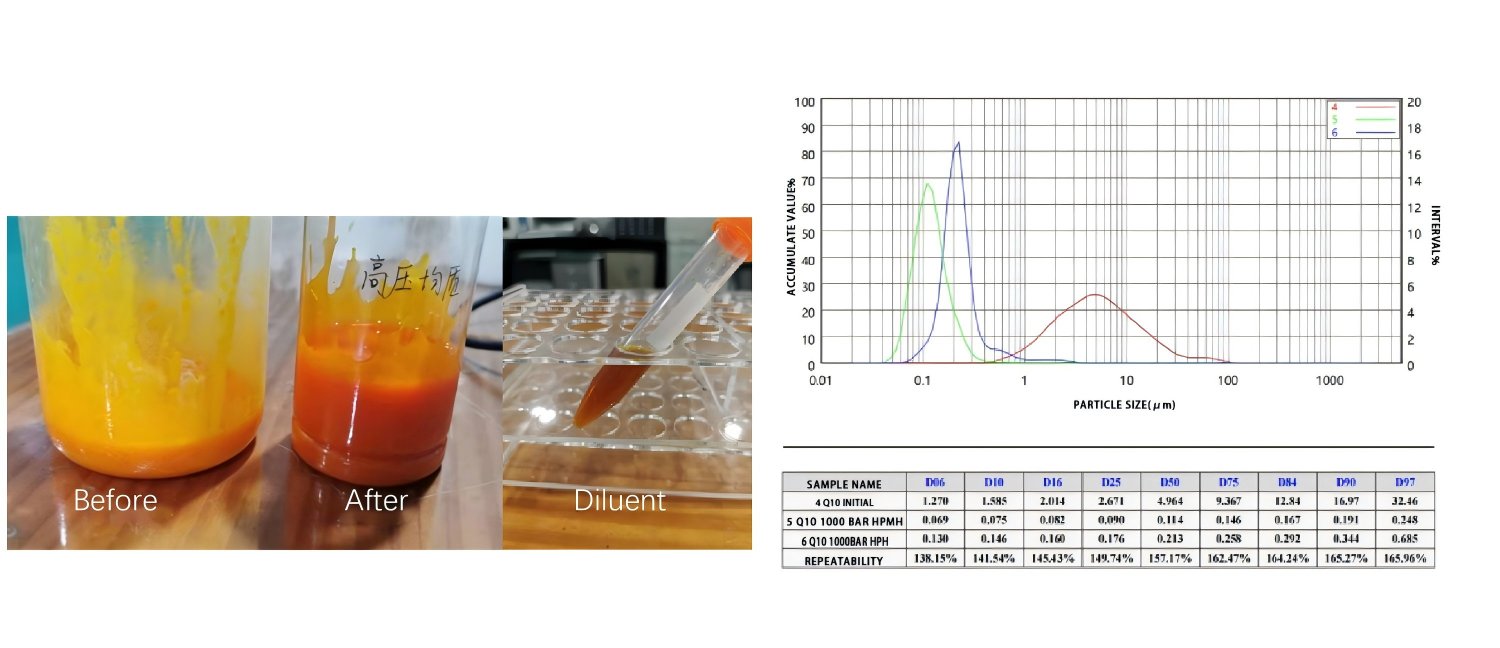
YOCELL can provide various models and specifications of high-pressure microfluidization homogenizers to meet the process requirements at different stages.