Astaxanthin is a natural carotenoid widely found in marine organisms such as shrimp, crabs, and salmon, as well as in Haematococcus pluvialis.
Astaxanthin offers excellent skincare benefits and is a true all-rounder in the skincare industry:
Powerful Antioxidant: It neutralizes free radicals, with antioxidant capacity far exceeding that of vitamin E and beta-carotene, helping to delay skin aging.
Protection Against Photo-Damage: It defends against UV damage, reduces tanning and sunburn, and minimizes fine lines caused by photoaging.
Reduces Dullness and Dark Spots: It inhibits melanin production, brightens the complexion, and improves acne scars and hyperpigmentation.
Repairs the skin barrier: Reduces skin inflammation, soothes redness, and improves sensitive, dry, and rough skin.
Firms and reduces wrinkles: Reduces collagen loss, smooths out fine lines caused by dryness, and enhances skin elasticity.
Improves skin texture: Enhances the skin’s ability to retain moisture, provides long-lasting hydration, and leaves the skin feeling finer and smoother.
Challenges in the Application of Astaxanthin in Cosmetics:
Although astaxanthin possesses significant antioxidant properties, its use in cosmetics presents several challenges:
Poor stability: It oxidizes and decomposes very easily when exposed to light, oxygen, or high temperatures, causing it to rapidly lose its activity.
Extremely poor water solubility: Pure astaxanthin is fat-soluble, making it difficult to add directly to water-based skincare formulations.
Low bioavailability: Due to its large molecular structure, it struggles to penetrate the stratum corneum, resulting in low absorption and utilization by the skin.
Microfluidization high-pressure homogenization technology can successfully address the challenges associated with the application of astaxanthin in the cosmetics industry.
By forcing a fluid through special microchannels under high pressure, intense shear, collision, and cavitation effects are generated, resulting in ultra-fine processing of the material. The active ingredients are then encapsulated into microscopic particles to form micro- and nano-liposomal formulations, thereby achieving a stable state for the active ingredients.
Benefits of using microfluidization high-pressure homogenization technology to produce astaxanthin nanoliposomes:
Improved water solubility: The treated astaxanthin is miscible with water in any ratio, forming a stable nanoscale liposome dispersion system.
Improved stability: The liposomes tightly “encapsulate” astaxanthin, isolating it from the external environment, which significantly reduces the risk of oxidative degradation and allows astaxanthin to maintain its activity in the product for an extended period.
Improved bioavailability: Astaxanthin treated with microjet technology penetrates the skin’s stratum corneum more easily, significantly enhancing its absorption and utilization efficiency in the skin, thereby fully unleashing its skincare benefits.
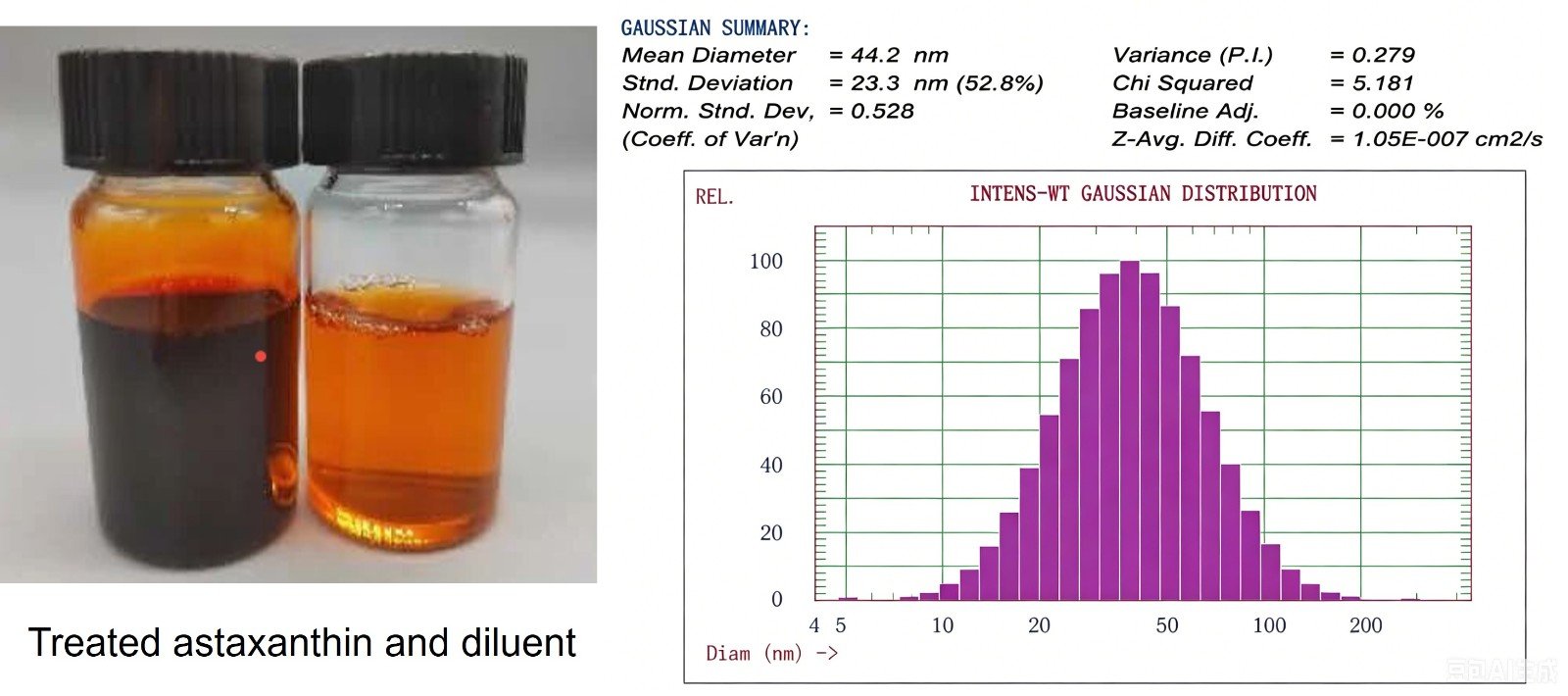
YOCELL can provide various models and specifications of microfluidization high-pressure homogenizers to meet the process requirements at different stages.